BAL-12.5 vs BAL-19: what's the difference for your build?
Oct 5, 2026
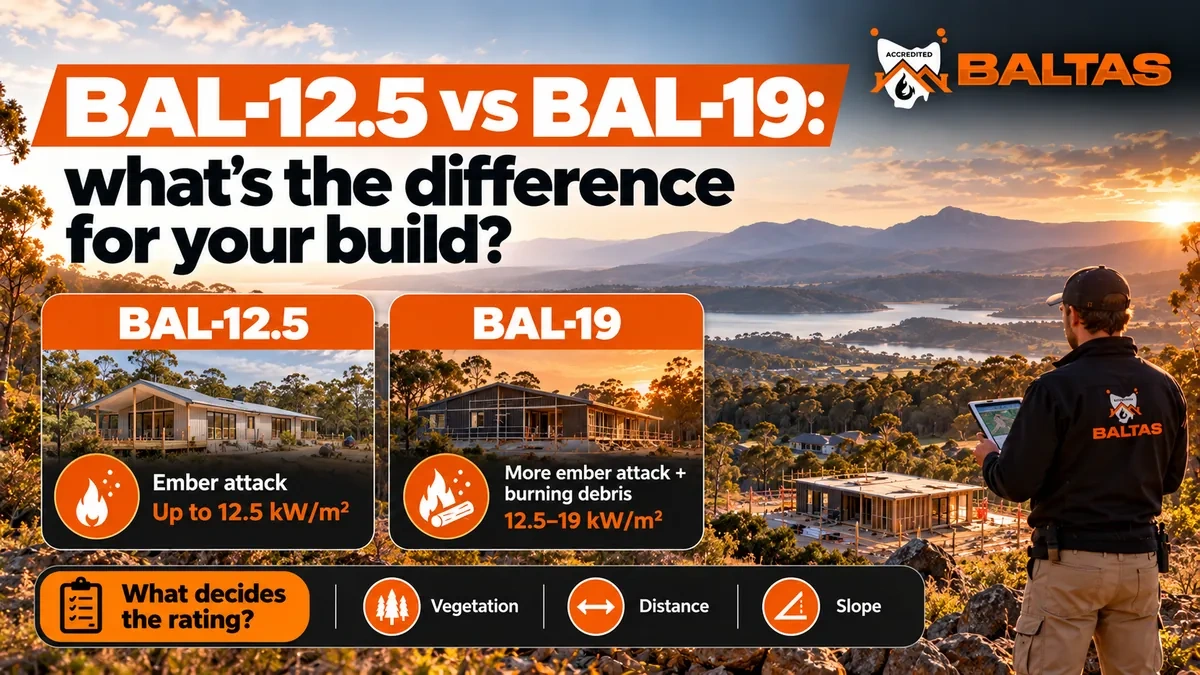
If you're building in a bushfire-prone area in North East Tasmania, your BAL report will give your site a Bushfire Attack Level, or BAL. Two of the most common ratings we see are BAL-12.5 and BAL-19. They sound close, and they are, but there are some differences worth knowing before you talk to your builder.
What the numbers mean
The BAL rating is a measure of how much radiant heat and ember attack your building could be exposed to in a bushfire. The number is the radiant heat level in kilowatts per square metre.
BAL-12.5 means the main risk is ember attack, with radiant heat up to 12.5 kW/m².
BAL-19 means more ember attack and burning debris, with radiant heat between 12.5 and 19 kW/m².
The ratings go from BAL-LOW up to BAL-FZ (Flame Zone). BAL-12.5 and BAL-19 are at the lower end, which is good news. Most standard homes can be built to these levels without major changes to the design.
What decides your rating
Your rating depends on three main things:
the type of vegetation around your site (forest, woodland, scrub, grassland and so on)
how far that vegetation is from your building
the slope of the land under the vegetation
Vegetation on a downslope is worse, because fire travels faster uphill. So two blocks in the same street can end up with different ratings.
What changes in the build
Your builder will follow the Australian Standard AS 3959, which sets out the construction requirements for each BAL. The step from BAL-12.5 to BAL-19 is small. The differences are mostly in the details, such as:
the type of timber that can be used in some places, like window frames and decking
glazing and materials close to the ground or near decks
how gaps and openings are sealed against embers
Your builder or designer will know what applies to your plans. It's a good idea to give them a copy of your BAL report early, so they can price the job correctly.
Can I get a lower rating?
Sometimes. The main way is to increase the distance between your building and the vegetation. This is done through the hazard management area shown in your Bushfire Hazard Management Plan. This is the area around the building where vegetation is kept low and managed.
Moving the building further from the bush can also help, if your block allows it. We can look at this during the assessment and let you know if a small change to the building position would make a difference.
Keeping your rating valid
Your BAL rating is based on the site as it is managed. If the hazard management area isn't maintained, or the building moves, the rating may no longer be accurate. Keep the grass short, remove dead material, and keep the area clear as shown on your plan.
Need a BAL report?
We prepare BAL reports and Bushfire Hazard Management Plans across North East Tasmania, including Gladstone, Scottsdale, St Helens, George Town and Launceston. All reports are reviewed through the Tasmania Fire Service, so please allow up to 6 weeks. Get in touch to book a site visit.